This product was not featured by Product Hunt yet. It will not be visible on their landing page and won't be ranked (cannot win product of the day regardless of upvotes).
SB-01: Pure GLSL Tourbillon
Where high mathematics meets digital haute horlogerie
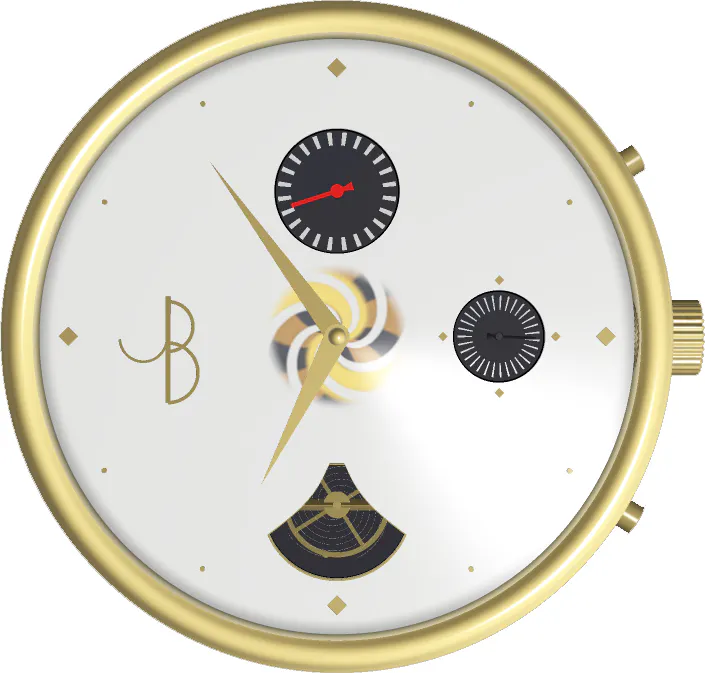
SB-01 is a pure mathematical digital art piece created by ST3PH-X to push the boundaries of modern WebGL and mobile graphics. Built entirely with raw GLSL shaders, Raymarching, and SDF geometry, this interactive experience renders a high-end conceptual mechanical watch in real-time — with zero external 3D models or heavy textures.
Hey Product Hunt,
I’m Stephaniia. I’m a creative engineer, and I love building things for the web that push the limits of mobile browser performance.
The SB-01 is my personal statement on minimalism and digital craftsmanship. I wanted to see if I could build a complex, high-complication mechanical tourbillon using absolute zero external libraries. No Three.js, no react-three-fiber, and no heavy assets.
Everything you see is written entirely in raw, hand-crafted GLSL shaders using Signed Distance Fields (SDF) and raymarching. Every single bridge, wheel, and sub-dial is pure math calculated directly on the GPU in real-time. If you look closely at the lower indicator, the distance field mathematically morphs into the branding, forming an S-B monogram in the negative space.
My dev setup is as minimalist as my code. I built this entirely inside Google Cloud Shell using their built-in terminal editor with simple syntax highlighting. I’ve always believed that you don't need heavy IDEs, local environments, or massive frameworks to write good programs. When you master the mathematics of the GPU, a web browser shell is all you need to create luxury.
It doesn’t click, it doesn’t push notifications, and it won't sell you anything. It just runs. Like a Marantz amplifier or a mechanical caliber, the value is entirely in the invisible engineering.
The live link is up. Open it on any device, look through the geometry, and let me know what you think of the math! I’m around in the comments if you want to talk shaders, SDFs, or low-level web graphics. For collaboration and custom WebGL inquiries, feel free to reach out directly.
Thank you for the support! 🚀
As this Product Hunt launch day starts to wrap up, I just wanted to say a massive, heartfelt thank you to everyone. Seeing how this community embraced Steph-Watch SB-01, and reading all your brilliant questions about the escapement details, tourbillon optimization, and shader bridges... honestly, it gave me goosebumps. I’m still sitting here trying to process all this incredible energy.
But if I’m being completely honest, all this launch day noise, fighting for leaderboard ranks, and clever marketing tech-talk—it’s just the tip of the iceberg.
While I was locked in my code editor, packing this entire mechanical caliber into a single, solitary fragment shader, a very strange and almost eerie thought kept hitting me. Why am I doing this? Why spend days and nights forcing a GPU to crush millions of trigonometric functions per second just to make gears turn on a screen—gears that don't even physically exist?
And then it hit me. I’m just testing the limits. My own limits, the limits of the technology, and the boundary of how much of our physical reality can be compressed into a raw mathematical function.
And you know what? The deeper I went, the more I felt this bizarre sense of déjà vu. When you build an entire tangible universe from absolute scratch—with its own rules of time, light propagation, metallic friction, and moving hands—just by writing the laws of physics into a blank text file... you can’t help but wonder. What if the Creator of our own universe (or whoever engineered this specific version of our simulation) used the exact same approach?
What if our mountains, oceans, atoms, and the very perception of passing time are just some mind-bogglingly beautiful, infinite, code-golfed shader rendering right now on some cosmic GPU? And we are just living out our hardcoded loops inside it.
Anyway, I didn't mean to get too metaphysical, but this project truly forced me to see code as something sacred. It showed me that mathematics can feel alive.
Thank you again to every single person who shared this journey with me today. The direction is set, and I’m moving forward. SB-02 is already taking shape, and believe me, the math there is going to be even closer to building a pocket-sized universe.
Sending love to you all! 🕰️🖤
How does it hold up on mid-range phones since it's running raymarching in real time?
The fact that a whole conceptual tourbillon comes to life with nothing but raw GLSL and raymarched SDFs is honestly wild. Really clean execution on the geometry too, the gear details hold up surprisingly well in real time.
The raymarching approach with raw GLSL is genuinely impressive, especially how fluid the tourbillon stays on mobile. Love seeing something this technically ambitious lean into pure shader work instead of leaning on models.
As promised, here is a deep technical breakdown of how the mechanical components around the 11 o'clock position are engineered inside the single fragment shader pipeline! 🛠️📐
Since everything in SB-02 is rendered with zero polygons using pure WebGL2 raymarching, modeling traditional horological elements like apertures and bridge plates requires precise constructive solid geometry (CSG):
1. The Apertures (Dial Cutouts): To expose the strike train underneath, I implemented a strict boolean subtraction operation. From the base dial disk SDF, I mathematically subtracted the complex geometry of the windows. The sharp edges are blended using smooth minimum functions (smin) to generate a realistic polished beveled edge (chamfer) instead of raw aliased pixels.
2. The Bridge Plates: The complex structural curved shapes of the bridges holding the repeater components are constructed by combining custom capsule primitives and rounded box SDFs through boolean unions, evaluated along an inverted polar coordinate space to contour perfectly with the main case.
3. Brushed Metal & Fasteners: The rivets are periodic spatial repetitions of sphere SDFs with micro-offsets. The high-end brushed steel finish on the plates is achieved via a custom high-frequency procedural noise function injected right into the Blinn-Phong lighting loops to mimic physical anisotropic micro-scratches stretching along the gear trains.
Would love to hear your thoughts on this GPU-only approach to micro-mechanics! What component should I model next? 🚀
A sneak peek into the future: SB-02 Under Development! 🛠️👁️
For everyone closely watching the launch, I couldn't resist sharing a quick preview of my next-generation caliber.
If you look closely around the 11 o'clock position, you can see the newly modeled apertures and bridge plates built completely from scratch using math functions. These bridges are designed to hold the complex strike train for the upcoming quarter repeater mechanism!
Also, notice the dedicated sub-second dial at the bottom, operating on its own isolated mathematical loop.
We are just getting started today. Stay tuned, because I’ll be dropping a deep technical breakdown of how I’m engineering these mechanical repeater components inside a single GLSL fragment shader very soon! 🚀
How does it hold up on mid-range Android devices, especially with the raymarching being done purely on the GPU? Curious if frame rates stay smooth without thermal throttling kicking in.
the detail on the tourbillon is genuinely wild for something running as a shader, and it stayed smooth on my phone which i did not expect.
Mid-launch update! 🕰️✨
Good morning to California and everyone joining the launch right now! I am absolutely blown away by the technical feedback I’ve received so far today. Knowing that fellow shader developers and clockwork enthusiasts appreciate the raw GLSL code-golfing behind Steph-Watch SB-01 means the world to me.
Right now, as the launch is rolling, I’m already back in my code editor pushing the boundaries further. I’m currently modeling the next step of this micro-mechanical simulation — a pure mathematical quarter repeater mechanism ( наручные часы с боем) with custom SDF gong hammers and springs evaluated entirely on the GPU!
Drop your tech questions below, I’m online and ready to dive deep into the math with you! Let's keep this momentum going! 🚀
How does this perform on mid-range Android devices — does the raymarching stay smooth or does it tank without a desktop GPU backing it up?
How does it actually run on mid-range phones without dropping frames, given the complexity of the raymarching?
how smooth does it actually run on mid-range phones, and does it drain battery fast because of the real-time raymarching?
How does it actually perform on mid-range mobile devices given the heavy raymarching workload, and is there any fallback for older GPUs that might not fully support the required shader features?
the gear mechanism rendered purely in GLSL with raymarching is honestly wild, you can tell every component was thought through down to the escapement details
About SB-01: Pure GLSL Tourbillon on Product Hunt
“Where high mathematics meets digital haute horlogerie”
SB-01: Pure GLSL Tourbillon was submitted on Product Hunt and earned 10 upvotes and 26 comments, placing #44 on the daily leaderboard. SB-01 is a pure mathematical digital art piece created by ST3PH-X to push the boundaries of modern WebGL and mobile graphics. Built entirely with raw GLSL shaders, Raymarching, and SDF geometry, this interactive experience renders a high-end conceptual mechanical watch in real-time — with zero external 3D models or heavy textures.
SB-01: Pure GLSL Tourbillon was featured in Design Tools (262.2k followers), Art (20.2k followers) and Developer Tools (518.5k followers) on Product Hunt. Together, these topics include over 129.8k products, making this a competitive space to launch in.
Who hunted SB-01: Pure GLSL Tourbillon?
SB-01: Pure GLSL Tourbillon was hunted by Stephaniia B.. A “hunter” on Product Hunt is the community member who submits a product to the platform — uploading the images, the link, and tagging the makers behind it. Hunters typically write the first comment explaining why a product is worth attention, and their followers are notified the moment they post. Around 79% of featured launches on Product Hunt are self-hunted by their makers, but a well-known hunter still acts as a signal of quality to the rest of the community. See the full all-time top hunters leaderboard to discover who is shaping the Product Hunt ecosystem.
Want to see how SB-01: Pure GLSL Tourbillon stacked up against nearby launches in real time? Check out the live launch dashboard for upvote speed charts, proximity comparisons, and more analytics.

 Stephaniia B.