This product was not featured by Product Hunt yet. It will not be visible on their landing page and won't be ranked (cannot win product of the day regardless of upvotes).
Rustly
See where coding agents spend tokens, context and money.
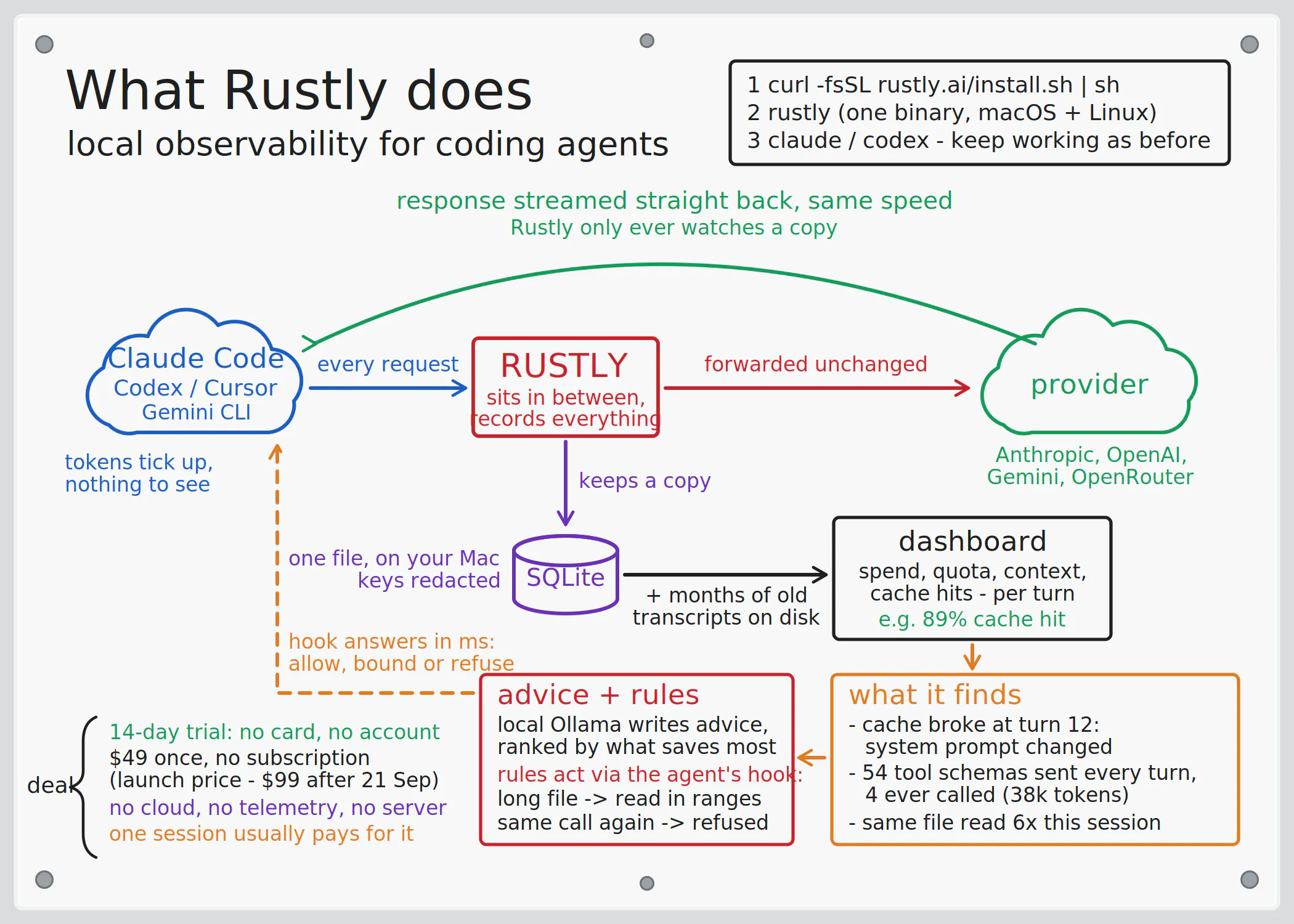
Rustly records every request Claude Code, Codex and Cursor make to their providers and shows exactly where your tokens, context window and money go. Find the turn that broke your prompt cache, the tool schemas nobody calls, and the work done twice. Runs entirely on your machine. $99, one payment.
I put a local proxy between my coding agents and their providers and recorded every request for 30 days. 87 sessions, two agents, 6.84B tokens of context read, 98% cache hit ratio.
Then I ran a set of findings over it to answer one question: how much of that context was avoidable? The answer was 10.12M tokens, broken down like this:
- Files read whole through the shell (sed, cat, nl): 6.16M, 60.9%
- The same work done more than once: 1.71M, 16.9%
- The agent looking at git again: 855k, 8.4%
- The message history rewritten (compaction, edits): 720k, 7.1%
- The same check run again and again: 616k, 6.1%
- The system prompt changed mid-session: 60k, 0.6%
- MCP servers never called: 97 tokens, so effectively zero, because I had already pruned them
That is an upper bound. Some of those reads and diffs needed to be that big. But the shape surprised me: the waste is not exotic. It is the agent using sed and cat as its file reader, then carrying the whole output for the rest of the session.
The 98% cache hit ratio is why none of this is visible from the bill. Cached tokens are cheap, so the number stays small, but they still fill the window and drag the session toward compaction, which is exactly when the cache breaks.
Things I changed as a result: told the agent to ask for line ranges instead of whole files, run checks once after a batch of edits, and check git once per task rather than after every step.
The proxy is Rustly, which I wrote. Runs locally, records to SQLite, nothing leaves the machine. https://rustly.ai
Rustly's tools page breaks the shell calls down by program and subcommand, and for each one shows what its output added to the context. It counts each call once, for the first real command in it, so cd repo && git status counts as git status.
The finding on my traffic: whole-file reads through the shell were the single largest source of avoidable context. 6.16 million tokens in 30 days.
Nothing leaves your machine. One binary, one SQLite file.
https://rustly.ai
No comment highlights available yet. Please check back later!
About Rustly on Product Hunt
“See where coding agents spend tokens, context and money. ”
Rustly was submitted on Product Hunt and earned 2 upvotes and 2 comments, placing #160 on the daily leaderboard. Rustly records every request Claude Code, Codex and Cursor make to their providers and shows exactly where your tokens, context window and money go. Find the turn that broke your prompt cache, the tool schemas nobody calls, and the work done twice. Runs entirely on your machine. $99, one payment.
Rustly was featured in Productivity (661.3k followers) and Artificial Intelligence (479.2k followers) on Product Hunt. Together, these topics include over 285.4k products, making this a competitive space to launch in.
Who hunted Rustly?
Rustly was hunted by Peter van de Put. A “hunter” on Product Hunt is the community member who submits a product to the platform — uploading the images, the link, and tagging the makers behind it. Hunters typically write the first comment explaining why a product is worth attention, and their followers are notified the moment they post. Around 79% of featured launches on Product Hunt are self-hunted by their makers, but a well-known hunter still acts as a signal of quality to the rest of the community. See the full all-time top hunters leaderboard to discover who is shaping the Product Hunt ecosystem.
Want to see how Rustly stacked up against nearby launches in real time? Check out the live launch dashboard for upvote speed charts, proximity comparisons, and more analytics.

 Peter van de Put