This product was not featured by Product Hunt yet. It will not be visible on their landing page and won't be ranked (cannot win product of the day regardless of upvotes).
Open-source MLSecOps Practical Reference Guide for AI security, machine learning security, LLM/RAG/agent security, secure MLOps, and ML supply chain controls.
What inspired you to build this?
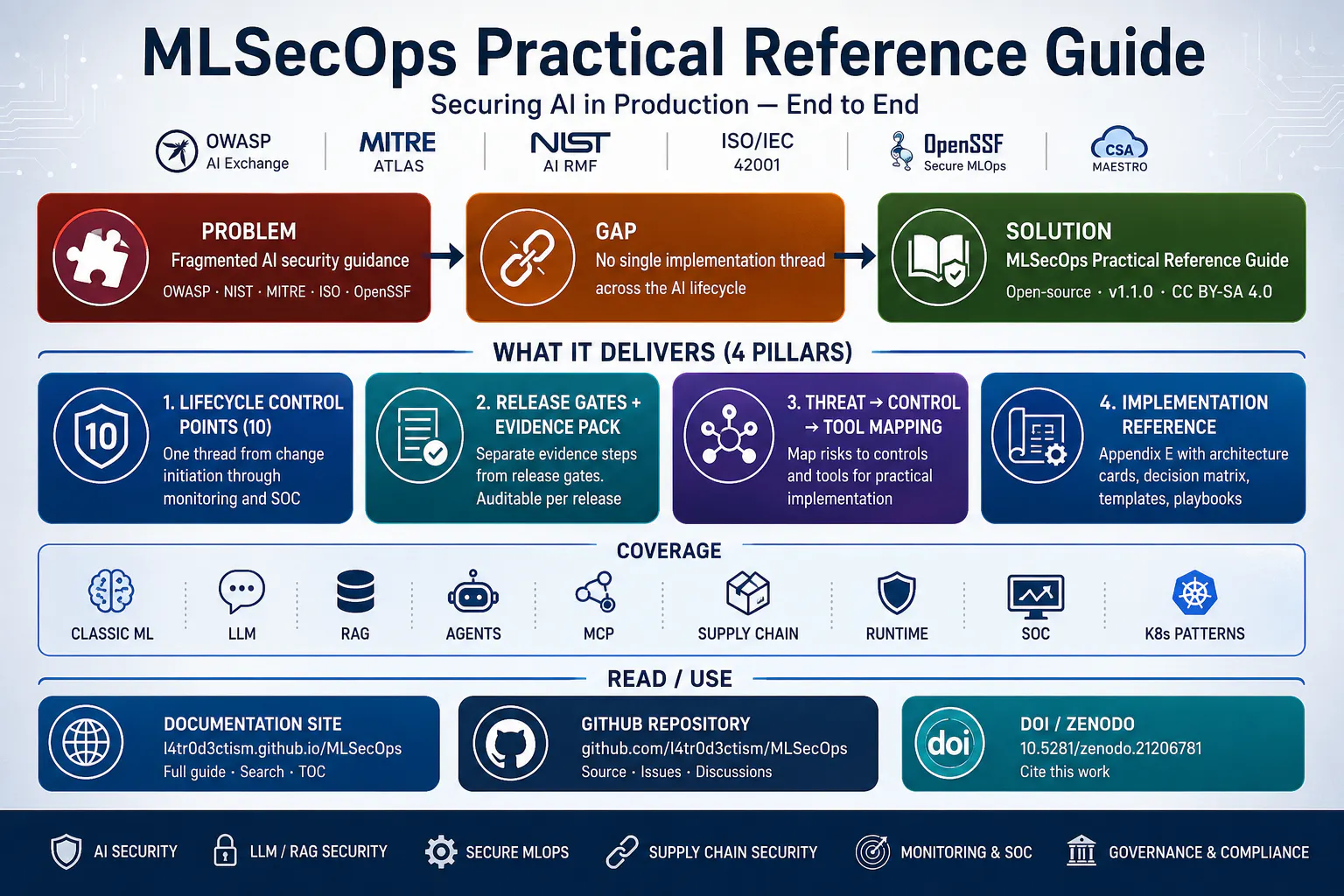
I kept seeing the same pattern in teams shipping ML, LLM, and agent systems: plenty of security frameworks, but no single place to turn them into day-to-day decisions — where to put a gate, what evidence to keep, how RAG ACL relates to release review, or how SOC should watch model behavior after go-live.
OWASP, MITRE ATLAS, NIST AI RMF, ISO/IEC 42001, OpenSSF, and CSA MAESTRO are valuable, but they speak different languages. Security engineers, MLOps, and architects were stitching PDFs, blog posts, and vendor docs together under deadline pressure.
I wanted an open, practitioner-oriented reference — not another standard, not a product pitch — that one team could use from threat modeling through governance without losing the lifecycle thread.
What problem were you trying to solve?
The core problem: DevSecOps and classic AppSec don’t fully cover AI production risk. Attack surface lives in data, model artifacts, prompts, embeddings, retrieval pipelines, agents, and runtime behavior — not only in application code.
The second problem: Guidance is fragmented. Teams struggle to:
map threats to concrete controls and tools;
separate evidence-producing steps from real release gates;
produce auditable outputs for security or compliance review;
roll out LLM/RAG/agent patterns without reinventing architecture each time.
The guide tries to answer: “What do we actually do this sprint?” — with lifecycle control points, an Evidence Pack, threat–control–tool mapping, and an Implementation Reference (Appendix E) for common deployment patterns.
How did your approach or process evolve while working on this launch?
It started as a synthesis document: connect existing frameworks into one MLSecOps lifecycle narrative. Early readers (including GitHub Issues #1 and #2) pushed for more honesty and traceability — which claims come from OWASP/NIST vs. author implementation opinion vs. emerging research.
That feedback shaped v1.1.0:
References / Source mapping on every major section;
complementary integration with OWASP AI Exchange (not a duplicate);
a clearer “guide at a glance” in Chapter 1 for executives and new readers;
stronger onboarding: role-based paths, Persian summary, GitHub Pages, PDF/DOCX releases, and Zenodo DOI for citation.
The process also taught me this isn’t a “write once and forget” handbook. AI security moves fast — LLMs, agents, MCP, supply chain — so open source + community review matters more than pretending the text is frozen forever. The launch is stable (v1.1.0), but the model is living documentation: issues, discussions, and minor releases as the field and reader feedback evolve.
No comment highlights available yet. Please check back later!
About MLSecOps Practical Reference Guide on Product Hunt
“Open-source MLSecOps for AI security, LLM/RAG”
MLSecOps Practical Reference Guide was submitted on Product Hunt and earned 0 upvotes and 1 comments, placing #117 on the daily leaderboard. Open-source MLSecOps Practical Reference Guide for AI security, machine learning security, LLM/RAG/agent security, secure MLOps, and ML supply chain controls.
MLSecOps Practical Reference Guide was featured in Artificial Intelligence (477.4k followers), GitHub (41.4k followers), Development (6.1k followers) and Security (2.9k followers) on Product Hunt. Together, these topics include over 154.8k products, making this a competitive space to launch in.
Who hunted MLSecOps Practical Reference Guide?
MLSecOps Practical Reference Guide was hunted by moslem haghighian. A “hunter” on Product Hunt is the community member who submits a product to the platform — uploading the images, the link, and tagging the makers behind it. Hunters typically write the first comment explaining why a product is worth attention, and their followers are notified the moment they post. Around 79% of featured launches on Product Hunt are self-hunted by their makers, but a well-known hunter still acts as a signal of quality to the rest of the community. See the full all-time top hunters leaderboard to discover who is shaping the Product Hunt ecosystem.
Want to see how MLSecOps Practical Reference Guide stacked up against nearby launches in real time? Check out the live launch dashboard for upvote speed charts, proximity comparisons, and more analytics.

 moslem haghighian