This product was not featured by Product Hunt yet. It will not be visible on their landing page and won't be ranked (cannot win product of the day regardless of upvotes).
Wave-state computing architecture and 0.356nm diamond memory: Replaces discrete binary transistors with a quantum wave-state computing engine and a Lab-Grown Diamond (LGD) 0.356nm lattice memory architecture. Overcomes thermal bottlenecks, scaling limits, and memory capacity constraints by leveraging intrinsic wave properties across continuous phase/frequency transitions for high-density, non-volatile state encoding without thermal runaway.
Wave-state computing architecture-0.356nm diamond memory and Human-Bio Brain Interface:
Why
Conventional artificial digitization based on discrete binary transistor architectures faces fundamental scaling limits, severe thermal bottlenecks, and strict memory capacity constraints. To overcome these physical boundaries, this work redesigns the computing environment itself by leveraging the intrinsic wave properties inherent in all matter—the fundamental nature of universal information—to serve as the primary information processing unit.
What
We introduce an integrated framework combining a quantum wave-unit computing engine with a Lab-Grown Diamond (LGD) 0.356nm lattice memory architecture designed for high-density storage without thermal runaway.
How
Wave Engine: Replaces discrete binary logic gates with continuous phase/frequency wave-state transitions.
LGD Memory: Leverages atomic-scale 0.356nm diamond crystal unit cells for high-density, non-volatile state encoding.
To provide further technical context on my specification:
1. Wave-Logic vs. Discrete Transistor Mechanics
Rather than relying on binary high/low voltage gates, my architecture models information as continuous, phase-locked wave states. This removes the switching overhead and static power leakage associated with sub-nanometer silicon nodes, enabling continuous-state information density.
2. LGD 0.356nm Lattice Storage Dynamics
The memory framework utilizes the unit cell coordinates of Lab-Grown Diamond (0.356 nm lattice parameter) to achieve non-volatile, atomic-scale wave encoding. By exploiting diamond's exceptionally high thermal conductivity and wide bandgap, the system maintains phase coherence and high storage density without inducing thermal runaway.
3. Spatial Wave Interface & Holographic Projection
The proposed interface model targets key neural nodes (thalamic nuclei, limbic circuit, and hippocampal regions) via non-invasive wave phase synchronization. This establishes a direct pathway for spatial holographic field projection and physical-space metaverse synchronization without requiring invasive physical electrodes.
Call to Action
We have published the architectural specification and underlying theoretical models. We would value feedback from the community on the wave-logic state model, lattice encoding mechanics, and potential system-level integration.
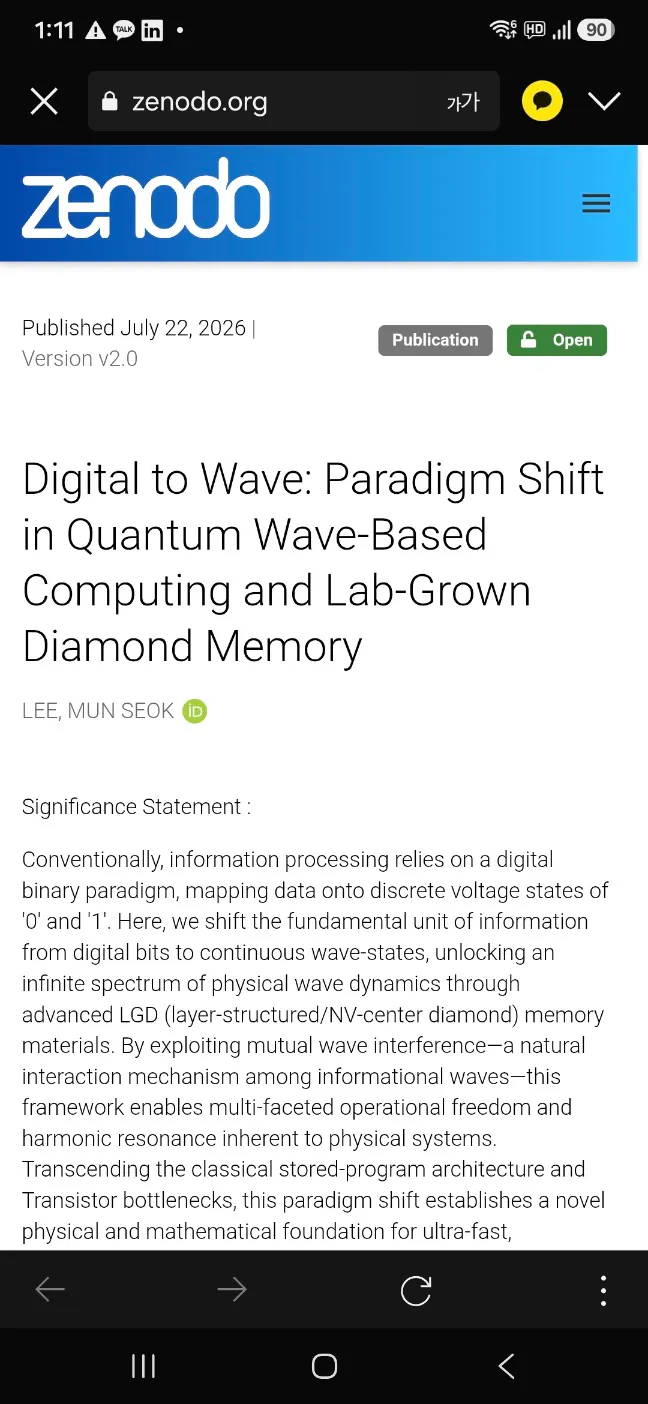
https://zenodo.org/records/21947036
1. Paradigm shift from von Neumann semiconductor-based computing to quantum wave-based computing, LGD (Lab-Grown Diamond) Memory-1, and human-brain wave interfaces-1.
https://zenodo.org/records/21947108
2. LGD (Lab-Grown Diamond) Memory-2, human-brain wave interfaces-2, wave interfaces with thalamic cells, the limbic system, and the hippocampus, along with holographics and physical-space metaverse holographics.
About Digital to Wave: Wave computing-Memory on Product Hunt
Digital to Wave: Wave computing-Memory was submitted on Product Hunt and earned 1 upvotes and 1 comments, placing #154 on the daily leaderboard. Wave-state computing architecture and 0.356nm diamond memory: Replaces discrete binary transistors with a quantum wave-state computing engine and a Lab-Grown Diamond (LGD) 0.356nm lattice memory architecture. Overcomes thermal bottlenecks, scaling limits, and memory capacity constraints by leveraging intrinsic wave properties across continuous phase/frequency transitions for high-density, non-volatile state encoding without thermal runaway.
On the analytics side, Digital to Wave: Wave computing-Memory competes within Biohacking, Computers and Physics — topics that collectively have 18.1k followers on Product Hunt. The dashboard above tracks how Digital to Wave: Wave computing-Memory performed against the three products that launched closest to it on the same day.
Who hunted Digital to Wave: Wave computing-Memory?
Digital to Wave: Wave computing-Memory was hunted by mun seok lee. A “hunter” on Product Hunt is the community member who submits a product to the platform — uploading the images, the link, and tagging the makers behind it. Hunters typically write the first comment explaining why a product is worth attention, and their followers are notified the moment they post. Around 79% of featured launches on Product Hunt are self-hunted by their makers, but a well-known hunter still acts as a signal of quality to the rest of the community. See the full all-time top hunters leaderboard to discover who is shaping the Product Hunt ecosystem.
For a complete overview of Digital to Wave: Wave computing-Memory including community comment highlights and product details, visit the product overview.

 mun seok lee