This product was not featured by Product Hunt yet. It will not be visible on their landing page and won't be ranked (cannot win product of the day regardless of upvotes).
Product upvotes vs the next 3
Waiting for data. Loading
Product comments vs the next 3
Waiting for data. Loading
Product upvote speed vs the next 3
Waiting for data. Loading
Product upvotes and comments
Waiting for data. Loading
Product vs the next 3
Loading
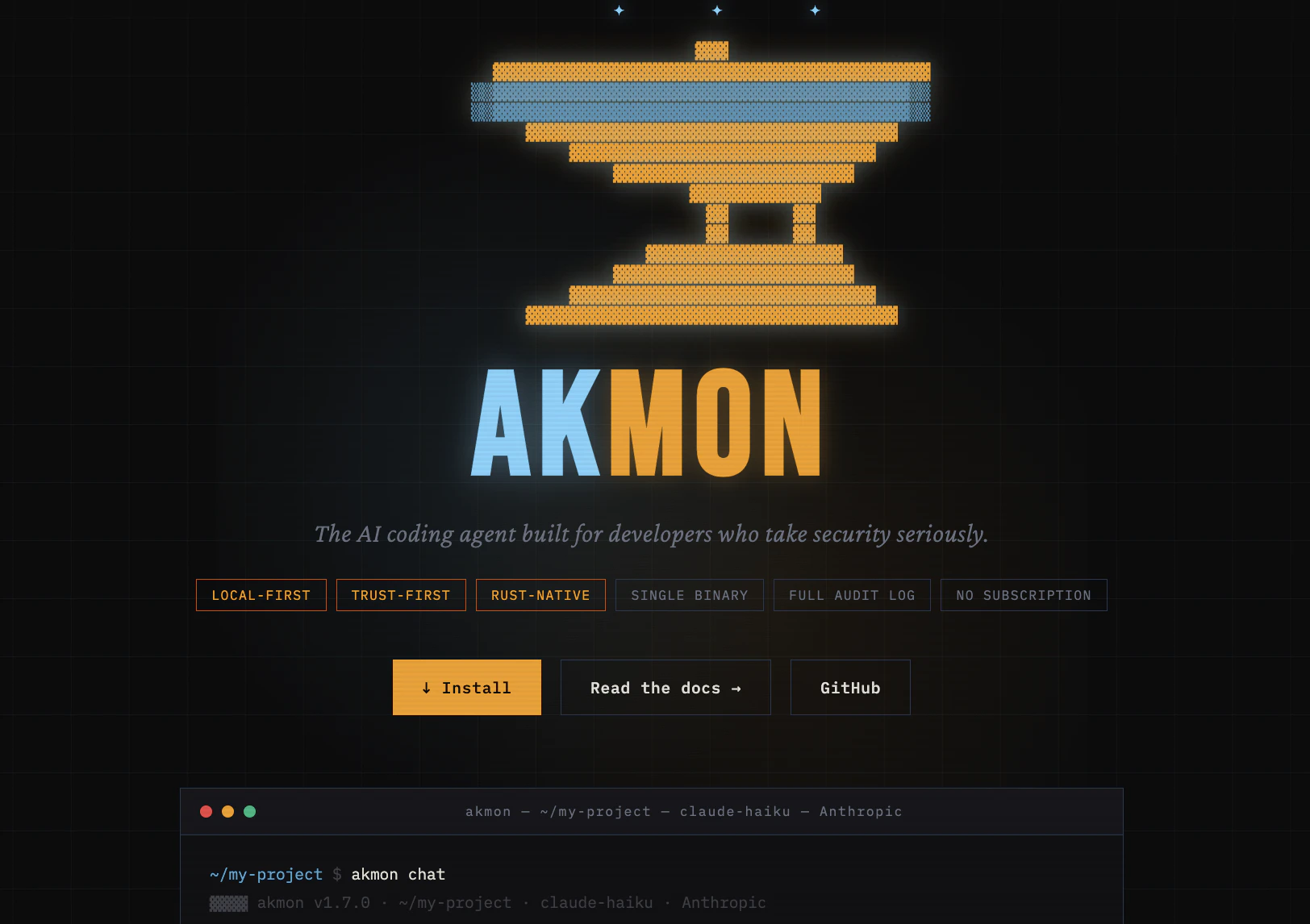
Akmon
AI coding agent. Single binary. Any model. Full audit trail.
Akmon is a terminal-native AI coding agent built as a single Rust binary with no runtime dependencies. It runs on laptops, SSH hosts, Docker, and CI, and can work fully offline with Ollama. Use Anthropic, OpenAI, OpenRouter, Groq, Azure OpenAI, Bedrock, or compatible endpoints. Akmon enforces typed permission checks for sensitive actions, supports model switching mid-session, and outputs JSON/audit logs for traceable, budget-capped automation.
Hi Product Hunt 👋
I'm Rado, the developer behind Akmon.
I built this because I kept running into a specific problem:
AI coding tools that work perfectly on a developer's laptop
but break completely in the environments where real software
actually gets built — CI pipelines, SSH servers, containerized
infrastructure, air-gapped networks.
The answer was a single statically linked Rust binary with
no runtime dependencies. 3.4 MB. Copy it anywhere and it works.
The three things I spent the most time on:
1. Provider independence. You should be able to switch from
Anthropic to Ollama to OpenRouter without changing how you
work. One tool, any model, your keys.
2. The audit trail. Every tool call logged with timestamps,
inputs, outputs, and costs. In professional environments you
need to know exactly what the agent did. JSONL means you can
grep it, pipe it into your observability stack, or just read it.
3. The permission system. Nothing runs silently. Every file
write and shell command requires explicit approval before
execution. This matters when you are working on production
codebases.
Still early days. The codebase is solid (~370 tests, clean
Rust architecture) but real-world usage always surfaces what
tests miss.
If you try it I genuinely want to know what breaks, what is
confusing, and what you wish it did differently. That feedback
is worth more to me right now than upvotes.
Happy to answer any questions about the architecture or design
decisions.
About Akmon on Product Hunt
“AI coding agent. Single binary. Any model. Full audit trail.”
Akmon was submitted on Product Hunt and earned 3 upvotes and 1 comments, placing #123 on the daily leaderboard. Akmon is a terminal-native AI coding agent built as a single Rust binary with no runtime dependencies. It runs on laptops, SSH hosts, Docker, and CI, and can work fully offline with Ollama. Use Anthropic, OpenAI, OpenRouter, Groq, Azure OpenAI, Bedrock, or compatible endpoints. Akmon enforces typed permission checks for sensitive actions, supports model switching mid-session, and outputs JSON/audit logs for traceable, budget-capped automation.
On the analytics side, Akmon competes within Open Source, Developer Tools, Artificial Intelligence and GitHub — topics that collectively have 1.1M followers on Product Hunt. The dashboard above tracks how Akmon performed against the three products that launched closest to it on the same day.
Who hunted Akmon?
Akmon was hunted by Radoslav Tsvetkov. A “hunter” on Product Hunt is the community member who submits a product to the platform — uploading the images, the link, and tagging the makers behind it. Hunters typically write the first comment explaining why a product is worth attention, and their followers are notified the moment they post. Around 79% of featured launches on Product Hunt are self-hunted by their makers, but a well-known hunter still acts as a signal of quality to the rest of the community. See the full all-time top hunters leaderboard to discover who is shaping the Product Hunt ecosystem.
For a complete overview of Akmon including community comment highlights and product details, visit the product overview.

 Radoslav Tsvetkov